Solutions · Data centre
Three-phase UPS for data centres
From a single edge room to a multi-megawatt hall, we size, supply, install and maintain the three-phase UPS that protects your IT load, every major brand, matched to your density, redundancy and growth.
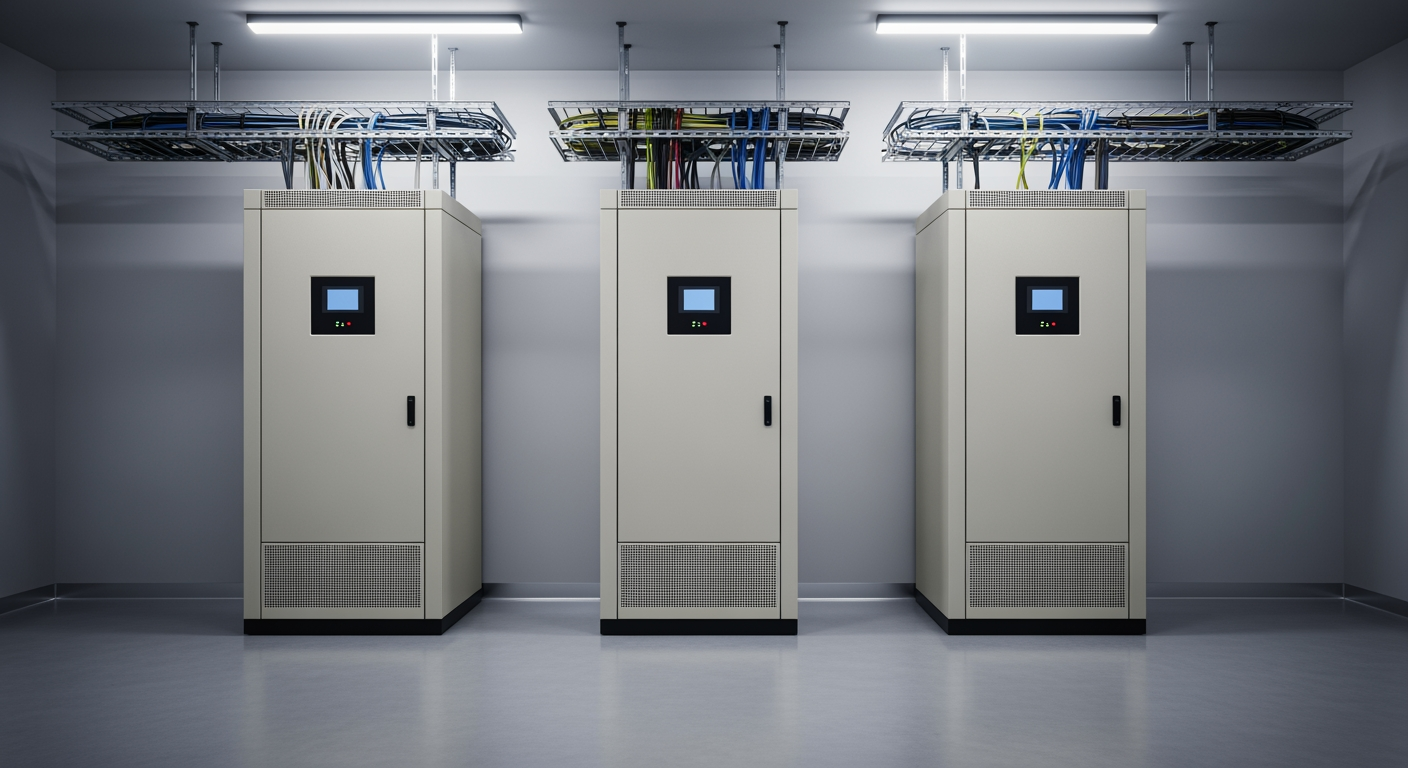
We start from the load, not the catalogue
Per-rack and total kW, the growth curve, redundancy (N+1, 2N), runtime, footprint and PUE targets come first. Then we specify the right system (modular where you want pay-as-you-grow, monolithic where density rules) and install and commission it with your electrical contractor.
What usually fits
Most data-centre rooms run modular online UPS in N+1 or 2N, with high-efficiency modes (eConversion, Energy Saver System, Dynamic Online) holding around 99% efficiency at partial load. Lithium-ion is increasingly the default for its footprint and life. We model all of it against your site before recommending anything.
Systems we often specify here
Maintenance: where data-centre uptime is actually won
Most UPS-related drops trace back to aged batteries, tired capacitors and fans, or alarms nobody was watching, not the electronics. A data-centre UPS programme pairs the hardware with scheduled preventive maintenance: annual electrical and thermal checks, capacitor and fan refresh at mid-life, firmware and alarm review, and battery testing on every string. Our service arm runs exactly this programme on high-capacity three-phase systems for mission-critical infrastructure, single units to multi-megawatt halls, every major brand.
Data-centre UPS service, coast to coast
Installation, commissioning, preventive maintenance and emergency response are delivered across Canada. Same-day service covers Montreal, Quebec City, Toronto and Ottawa. Elsewhere, including Vancouver, Calgary and Edmonton, the response is 24 to 48 hours. Scope by service is on the UPS service page, and data-centre UPS maintenance and emergency response covers white-space projects from the first load onward.
Scoping a new build or comparing markets? The independent Canada Data Centre Map catalogues Canadian data centres, campuses and active projects with primary sources, useful groundwork before sizing the power train.
Batteries and runtime for the white space
Runtime is a design number: enough to bridge generator start with margin (typically 5 to 10 minutes), engineered from the real load, not a guess. VRLA strings remain the capital-cost choice; lithium-ion roughly doubles calendar life and shrinks footprint. For battery cabinets, replacement strings and scalable runtime hardware in stock, start from the three-phase UPS family hub or browse stocked three-phase systems, both cover the exact families specified above, with battery options per family.
Common questions, UPS for data centres and server rooms
What UPS do data centres use?
Almost always three-phase, double-conversion online UPS, modular platforms (scalable frames with hot-swap power modules) in N+1 or 2N for the white space, and compact rack or tower online units for edge and server rooms. The systems we specify most are listed above; sizing starts from per-rack kW, growth and redundancy targets, not the brochure.
N+1 or 2N, which redundancy does a data centre need?
N+1 (one spare module or unit) covers a single failure and is the workhorse for most Canadian rooms. 2N (two independent power paths) removes the UPS as a single point of failure entirely and is standard where SLAs or Tier objectives demand concurrent maintainability. 2N roughly doubles the power train, so the decision is economics against downtime cost.
How often should data-centre UPS maintenance be done?
At minimum an annual preventive visit: electrical checks, capacitor and fan condition, firmware, alarm history and a battery test, with semi-annual battery inspections on VRLA strings. Batteries age out at 3 to 5 years and remain the leading cause of UPS-related drops; scheduled replacement beats emergency response every time.
VRLA or lithium-ion batteries in the data centre?
VRLA still wins on capital cost; lithium-ion wins on footprint, weight, calendar life (roughly double) and cooling tolerance, which is why new halls increasingly default to it. Both are valid; we model the ten-year cost against your space and thermal envelope before recommending either.
Guides for this application
Request a system quote
Tell us the application and we reply within 4 business hours with the sizing, the right system, the installation and a written quote. Three-phase installs usually need a licensed electrician, so let us know if you have one.
Brand names are trademarks of their owners and are used only to identify the equipment we service. We are not the manufacturer and are not affiliated with it.